Steps
1 to 4: Getting Started
Young
people sixteen and up please click here
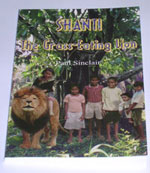
Step 1 - Get hold of a copy of Shanti the Grass-eating Lion. This website's purpose is to give simple instructions on how to set up action clubs and run them well. The book Shanti the Grass-eating Lion introduces the heartfelt inspiration and wisdom to make it all come alive in everyones heart. It's for all adults, young people and children alike, and all profits from the books sale go toward establishing and maintaining orphanages and other child welfare work. |
 |
Step 1a
- Get others involved.
| Take a copy of the information provided on the adult introduction page (In PDF) (In Microsoft Word) and see if you can find other adults who may want to help. It's almost always easier when there is a few of you all working together inspiring and encouraging each other. Besides all people have different talents and abilities to offer. You may find some may not want to become directly involved with helping to run the club but they can help you in other ways, for example identifying causes for you, helping you find a meeting place (Step 2 below), naming useful people for you to contact and so on. |  |
'An
individual has not started living until he can rise above the narrow confines
of his individualistic concerns to the broader concerns of all humanity.'
— Martin Luther King, Jr.
Step
2 - Find a comfortable place for the action club to meet regularly.
You need a place large enough for all your action club members to meet.
Local community meeting places and centres are best. These can be public
halls, scout halls, places of religious gathering, school halls to name
but a few. In some hot and dry countries, meeting in a park under a tree
may be sufficient.
Please note that in most developed countries you will be legally required
to have insurance against accidents and injuries, however unlikely their
occurrence may seem. The easiest way to solve this requirement is by finding
an organisation that will sponsor your action club and provide you a place
that is already insured against accidents and injuries. Such organisations
include schools, youth organisations and religious organisations. If they
require help to understand what action clubs are all about, just give
them a copy of the Introduction page for adults.
 |
Adult Introduction Page (In PDF) (In Microsoft Word) |
(You can get a
free copy of Adobe Reader for PDF files by clicking
here.)
Step 3 - Decide which age group the children or young people will
come from to begin with.
This will affect the projects you start with. The younger the children
the simpler the projects you will need to be to begin with. Below are
briefs on the needs and capabilities of the different age groups.
| Children
aged 5 - 6 years old Children aged 6 - 9 years old Children aged 9 - 12 years old Young people aged 12 years to 16 |
 |
Step 4 - Decide what projects
you want to start up with.
Fun is the name of
the game, especially to begin with. You will also need to choose projects
that are achievable and beneficial given the children or young people's
needs and capabilities. Choosing something that is really difficult for
a particular age group, takes a lot of hard work and shows little or no
results afterward will likely cause your members to lose interest. Once
the club is established, everyone knows each other, and it has become
a fun social event as much as anything, then more challenging tasks can
be chosen with the members. With teenagers in particular, once the club
is established the more challenging the task and the more self-sacrifice
required of them, the better for their personal development. This
is because at this time of their life they are learning to exercise and
develop their will power.
Warning: some adults may be tempted to use action clubs and the
good will of the volunteers to make profits. Please don't as this will
change the whole relationship between you, the action club members and
the people they are helping. You will be exploiting the children's and
young people's good nature, which will only do them harm and teach them
to distrust, because the truth always comes out in the end. This will
also damage the reputation of acton clubs and help to spoil things for
everyone, everywhere.
Here is a list of potential projects:
| Children
aged 5 - 6 years old Children aged 6 - 9 years old Children aged 9 - 12 years old Young people aged 12 years to 16 Young people aged 16 years up |
 |
Step
4 continued - Selecting a project to address a particular issue in your
community.
| If you or your fellow members
have been affected by a particular issue and feel strongly about it;
you may want to choose a project that addresses that specific need
in your community. The next thing to do would be to focus on a specific
area of that problem. For example, child labour is a big problem in
many countries. But there are many causes and driving forces behind
this. Tackling all of these causes at once would be too much and it
would likely lead to failure as the causes may not receive all the
individual attention they need. To be really effective and bring success
your project would need to sharpen its focus on one particular cause
at a time. For example, instead of child labour, you could focus on
children having to work long hours in your community and them missing
out on education. |
 |
 |
 |
© Shanti Lion Children's Trust: 2006, 2007
This Web page may be linked to any other Web sites. Contents may not be altered.