Education
for Life: Preparing Children to Meet the Challenges (Continued)
Please note direct word-for-word quotes from Education for Life are indicated
by single quotation marks.
Chapter 8: Humanizing the Process (Making subjects more immediately
human. Particularly useful for teachers)
There is much '...that might be done with conventional subjects to impart
the basic principles of Education for Life. The important thing would
be to humanize the process as much as possible, that it be made relevant
to the actual needs and interests of the students.'
'The learning process ought
to be rooted in life itself, and therefore—for the teacher quite
as much as for the student—a thing fresh and wonderful every day.
Any teacher who really enjoys what he teaches, and who can spark a kindred
enjoyment in his students, has already mastered one of the central points
in the Education for Life system.'
J. Donald Walters offers a few excellent suggestions for how this humanizing
might be achieved to help spark other creative ideas in teachers’
minds.
| He covers humanizing history and how it can '...be vastly more enjoyable to learn the story of the past, and for that matter to teach it, in its relevance to actual needs of the present' (in terms of what lesson can be learned from it as a guideline for the students’ own present and future life). | 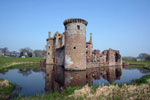 |
Next he deals with the instruction
of languages including a study of how languages evolve; of basic differences
between one language and another; of the source of words; and of 'how
the use of words actually helps to direct the way we think.' This is aimed
at making 'the student more flexible mentally, more aware of other ways
of thinking and looking at things than those to which he has been raised.'
He suggests getting to the inner core of languages through their individual
melody and rhythm and the art of learning languages through “tuning
in” to the general consciousness of the people who speak them.
This should include a study of a language's inner heart i.e. the people
who speak it—their history, their national traits, their heroes.
For 'mathematics, too, considerable interest in the subject might be sparked by including in the course a general history of mathematics. Interesting, too, would be a study of the lives of great mathematicians, and perhaps of the challenges they faced in getting their work accepted.'
'Great mathematicians often have a sense of the sheer poetry of numbers—a sense that is seldom hinted at, and perhaps not even imagined, by most teachers of mathematics courses.
'There is Pythagoras’s application of mathematics to the study of music: a fascinating subject, but one that is rarely even mentioned in the classroom.
'Of great and practical interest to students of algebra would be a study of the importance of symbolic logic in everyday life—of making definitions serve in place of complex realities as a means of simplifying one’s thoughts about them. The advantages, and also the disadvantages, of symbolic thinking make a fascinating and important study.'
| 'Children in the lower grades, on the
other hand, could have emphasized to them, when faced with arithmetic’s
immutable rules, the importance of accepting and adapting to things
as they are. Two plus two always makes four; it is not a matter of
whim. The children may have become used to getting their own way in
certain matters, but here is an example, selected from countless realities
in life, of something that no amount of wishing will be able to change.' Finally J. Donald Walters stresses the importance of fantasy for young children especially. |
 |
'History, for example, might be taught as though seen through the eyes of a child traveling back in a time machine to centuries long past, and relating what he sees to their own lives today.
'Geography, again,
might be taught as seen through the eyes of a boy and girl traveling to
distant places, and experiencing exotic sights in terms of their own immediate
realities.'
Chapter 8 in full can be found through this link for those who want to
go into greater depth.
 |
 |
© Shanti Lion Children's Trust: 2006, 2007
This Web page may be linked to any other Web sites. Contents may not be altered.