Education
for Life: Preparing Children to Meet the Challenges (Continued)
Please note direct word-for-word quotes from Education for Life are
indicated by single quotation marks.
| Chapter 9: The Importance,
to Understanding, of Experience (Practical methods for teaching the art of living) Most teaching today is of the blackboard, variety: “Spell it out, and you’ll understand it.” In other words to define a thing is to understand it. However an intellectual understanding of how to live is never sufficient. Practical experience is needed. |
 |
'Much can be accomplished in the way of giving children an Education for Life even while teaching standard classroom subjects. Special classes in the art of living need to be taught also, however, classes filled with narrative examples, practical illustrations, and useful techniques that the children themselves can practice in the classroom and at home.
'There need to be classes in self-expression; in understanding oneself and others; in the benefits of cooperation with others; in the true meaning of success; in how to succeed at anything; in how to have a positive influence on others; in joyful self-discipline; in the importance of right, positive attitudes; in the art of concentration; in developing memory; in general problem-solving; in secrets of achieving true happiness. The list given here is by no means exhaustive; it is intended to suggest a direction that, if pursued, will open up ever-fresh possibilities.'
'It is difficult, even in the most ordinary situations, to avoid artificiality when seeking to convey direct experience to a child. The very act of saying, “Now we’re going to experience how and why it is good to forgive others,” not only creates a false situation, but also encourages a merely superficial response.
'Obviously, then, teachers need to be aware of, and quickly responsive to, situations as they actually arise in the lives of their students. The test of a teacher’s wisdom will lie in his ability to recognize a problem, and to respond to it sensitively and appropriately.
'For instance, were a teacher to leap enthusiastically at every opportunity to instruct his students in the art of living the moment any such opportunity presents itself, he might well develop in them, gradually, a resentment toward all instruction in human values.'
| For
example when a child is hurt all they often need is little comfort
and sympathy. 'Love a child when he weeps, and he may be the more
ready to listen to reason after he’s calmed down. And maybe
it isn’t really reasoning that he needs anyway. 'It is difficult enough to deal wisely with living situations. It is far more difficult to create them artificially, for the purposes of instruction.' |
 |
'Much, however, can be accomplished by a sort of deliberate artificiality, in the form of fantasy: stories acted out; little dramatic pieces; story-reading that involves the children’s response and verbal participation.
'In this respect, an excellent lesson can be taken from the children themselves. For what is the universal game played by children everywhere, regardless of culture or nationality? Let’s pretend:'
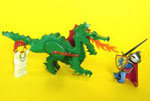
' “Here is the
dragon. He was once a soldier who wanted to protect his princess. One
day, he fought off the attack of an evil wizard who wanted to carry the
princess off to his dungeon. The wizard then cursed him to become a dragon,
and to become as mean and violent as dragons usually are.
' “Now that same dragon won’t let anyone near his princess,
and is doomed by the curse to lay the countryside to waste for miles around
with his fiery breath. No knight can destroy him, no matter how sharp
or shiny his sword.
' “If anyone can
forgive him, however—deeply, from his heart—his forgiveness
will break the evil spell cast by the wizard. By forgiveness, the
dragon will be turned back into a good and loyal soldier. And the
brave knight who saved him will marry the princess.” |
 |
'An important point to be realized, when helping children to achieve fresh insight into the problems they encounter in daily life, is that the intellectual understanding of a problem is not only insufficient, but often is not helpful at all. What is important is that they find themselves moving happily in a new direction, and not that they themselves understand all the reasons for the direction.'
'Who would kill the song in a child’s heart? Instead of explaining the benefits of living harmoniously, why not get the children simply to do whatever will help them to live in harmony with themselves and with others? Action, far more than words, will uplift them into a positive outlook.
'Singing, too, is a wonderful therapy. No need to explain to a child the reason singing is therapeutic. Just get him to sing. In music lies one of the best ways of bringing out the best in children.
'Dance is another excellent way. Body movements are closely allied to attitudes of the mind. It might also help children to make affirmations while moving their bodies.'
For example: 'Certain outward-reaching dance movements might be used with the affirmation, “I reach out with love to help my fellow creatures.”
'Upward-stretching movements might be accompanied by the affirmation, “I reach up to the heights within myself.”
'Downward gestures could accompany the affirmation: “I reach down to uplift all who weep.” '
| 'Painting,
too, can be a means of drawing out feelings in a child which, once
objectified, might be emphasized if the feelings are constructive,
or positively redirected if they are destructive. 'To share together in any activity, moreover, can help to harness excess energy and direct it positively. |
 |
'A final word: Never
underestimate the importance of fun to the over-all teaching process.
It is often during the moments of lightness, when the mind is diverted,
that the most fundamental lessons are absorbed.'
Chapter 9 in full can be found through this link for those who want to
go into greater depth.
 |
 |
© Shanti Lion Children's Trust: 2006, 2007
This Web page may be linked to any other Web sites. Contents may not be altered.