Action
Clubs for Older Youth
Why should we start an action club?
Look at the state of the world today and what's going on around you. The
world is in a mess. Many older adults are preoccupied with their own self-interests
and they are not very interested in you, your needs and the world they
will leave to you. For example, just look at how many take the environment
for granted and do little to reduce their own impact on it. It's pointless
getting mad with them because it's not their fault, they don't know any
better. Many haven't been brought up to think of anyone but themselves
to any significant extent.
| So why wait around for them to solve the world's problems? Why not set up an action club and do it yourselves? We will give you a list of problems and what can be done that are common to many communities and you can also look around your own community and see what needs to be done there. If your club comes up with a great way of helping the world and it works, tell us all about it so we can share it with other clubs and your idea can spread and do more good. |  |
'You must not lose faith in humanity. Humanity is an ocean; if a few drops of the ocean are dirty, the ocean does not become dirty.'
'You
must be the change you want to see in the world.'
— Mahatma Gandhi
What are some of the other benefits from being a part of an action club?
It will empower you by showing you that you can personally make a difference in the world, which will give your life more meaning. It will help you gain more acceptance and respect in your own communities as respect is earned. What better way to earn it than by contributing to society positively?
Other benefits include:
 |
Improved self-esteem and confidence |
|
Making connections with other people from all different cultural and economic backgrounds |
|
Mastering practical skills such as constructive problem solving, teamwork, leadership, organisational and planning skills to name a few |
'The
best way to find yourself is to lose yourself in the service of others.'
— Mahatma Gandhi
What are some of the activities action clubs get involved in?
Reducing local and global poverty; advocacy; campaigning for world peace,
civil rights, freeing political prisoners, saving the environment; protecting
rainforests, coral reefs, wetlands; improving community health and safety;
bringing the community together; working with people in need — helping
refugees, disaster victims, homeless people, elderly people, disabled
people, sick and hungry people, animals; the list goes on and on. Please
see our extensive list on our 'Project
Ideas' page.
'A small body of determined spirits fired by
an unquenchable faith in their mission can alter the course of history.'
— Mahatma Gandhi
How
to start an action club:
Starting
an action club is free. All you need to do is follow these step-by-step
instructions.
Do we need an older adult to run an action club?
| No, of course not; although the right
older adults can help by bringing their experience and connections
to others who might also be of help. The key is to find people who
will treat you all as equal partners and work with you and not try
to take over. Here are two advice sheets to help keep everything cool.
(For
Adults) (For
Youth) (You can get a free copy of Adobe Reader for PDF files by clicking here) |
 |
Do
we have to call our club a 'Shanti Action Club'?
No. Call your club whatever you want.
Who should we try to recruit to our action club?
Anyone who has an interest in doing something worthwhile to make a difference.
A useful guide on who to recruit can be found using this
link.
How it all began for us
| A few years ago Korak Day began a school for under-privileged women in one of the poorest and most dangerous parts of Kolkata, India. As he used to make his way to and from the school, he noticed there were many children loitering around, often getting into mischief and trouble. Their parents were too poor to send them to school and to Korak their future looked very bleak and hopeless. Life expectancy in this place is very short especially if you are uneducated. So he extended his school to them and now has over five hundred children. | 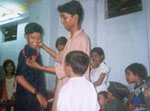 |
During these
early days he often used to notice that many in the local community,
particularly elderly people, were unable to clean up after themselves.
They needed help but how to go about helping them was another thing. It
was too much for him to do on his own. As the local area was a Muslim
area, Korak had been studying Islam in order to better understand the
local people and respect their culture. He came across a command given
by their prophet Muhammad that it is a Muslim's sacred duty to care for
and love his neighbour. It then went onto define a neighbour as everyone
in the forty houses to the north, south, east and west. This gave Korak
the idea for action clubs. So he gathered many of the children together
and told them that if they wished to be happy, they needed all those around
them to be happy. He then set them to work cleaning the neighbourhood.
This uplifted the whole community and made the children feel good about
what their efforts had achieved through seeing the smiles on the faces
of the people they had helped.
One of the main purposes of Shanti Action Clubs is to take Korak's
example and spread it all over the world.
 |
Bookmark or share this book
| Share on Facebook |

© Shanti Lion Children's Trust: 2006, 2007
This Web page may be linked to any other Web sites. Contents may not be altered.